Advertise on AstraPixels
Two things are for sale here, and they are not the same product. A body on the map that you buy once and keep is a claim. Rented attention on one of the map’s surfaces is a placement, billed monthly against impressions we measure and report back to you.
Everything below is the real thing. The tooltip, the peek sheet, the modal header and the native card are the same components a visitor sees, mounted here with sample creatives. The two map formats are screenshots taken from the running app. There is not a mockup on this page, because a mockup can drift from what you would actually receive and neither of us would find out until after you paid.
About the sample creatives
Perihelion, Kepler Labs, Lagrange Coffee and the rest are invented, and their links point at example.com. Nobody real is being shown here, and no real advertiser’s numbers are touched by this page: none of these surfaces reports an impression, and every fixture id is prefixed sample: so it could not be counted even if one somehow escaped.
Tooltip sponsor row
One dim line beneath the body's real name and a real fact, capped at 24 characters. It is the scarcest surface and the most intrusive, so it carries the strictest rules.
Desktop, on hover
 Telemetry, plainly
Touch, the peek sheet
A phone-width frame. The map stays visible above the sheet, which is why a first tap is cheap enough to be exploratory.
Touch devices have no hover, so tooltip hovers do not exist there. A tooltip buy is priced on desktop hovers only. Your creative still appears on the touch peek sheet, and those are reported to you as touch opens, separately, and are never blended into the hover count or into the rate. The modal header and the native card run on both.
The tooltip is not clickable, on either device. It follows the pointer, so a tooltip that accepted clicks would sit under the cursor and swallow the hover that produced it. The peek sheet and the modal surfaces are reachable and their sponsor rows do link out.
No sponsor row is rendered at system zoom at all. Hovers at that zoom are accidental cursor sweeps, so there is no inventory there to sell and billing for it would be fraud.
- Base rate
- $9 per month
- Measured attention
- $1.20 per 1,000 desktop hovers, against 0 in the trailing 30 days, so $0
- Founding-advertiser rate
- 50 percent of $9, because this surface has no measured history yet and you would be buying on a guess. It stops applying the day there is data, and the rate is then whatever the attention says.
- Published monthly rate
- $4.50 per month
Modal header strip
A labelled strip at the top of an object's detail modal, above the portrait and the facts. Desktop and touch.


Two and a half times the mass of the other seven planets combined.
The facts, the current position and the advertisers in orbit continue below this point in the real modal.
A modal is a surface a visitor deliberately opened rather than one a cursor swept across, which is why the header strip is allowed to carry the brand name as well as the copy. It is still a strip and not a headline, and the object’s own title sits below it at a heavier weight. Your pick is held for as long as the modal stays on one body, so the impression counted is the impression that was shown.
- Base rate
- $19 per month
- Measured attention
- $1.20 per 1,000 modal opens, against 0 in the trailing 30 days, so $0
- Founding-advertiser rate
- 50 percent of $19, because this surface has no measured history yet and you would be buying on a guess. It stops applying the day there is data, and the rate is then whatever the attention says.
- Published monthly rate
- $9.50 per month
Network native card
A rotating card inside every object's modal, network-wide rather than bound to one body. The cheapest way in.
Orbiting this object
- #0The object’s own content ends here
 Roasted for late shifts
The card rotates every 14 seconds between the advertisers sharing the surface, weighted by share of voice. Those weights are published in the map payload, so you can verify your own share rather than take our word for it: at weight 1 against a buyer at weight 3 you receive a quarter of the impressions, and your report page will say so. It does not rotate in the frame above, because a demo you have to wait through is a demo nobody reads.
Network placements fill surfaces nobody has bought. A buyer who paid for one object specifically is never diluted by the network tier rotating through it.
- Base rate
- $6 per month
- Measured attention
- $1.20 per 1,000 modal opens, against 0 in the trailing 30 days, so $0
- Founding-advertiser rate
- 50 percent of $6, because this surface has no measured history yet and you would be buying on a guess. It stops applying the day there is data, and the rate is then whatever the attention says.
- Published monthly rate
- $3 per month
Permanent positions on the map
Not rented and not monthly. These are claims: a position on the map you buy once, or lease by the year. The shots below are captured from the running app, because these formats exist only inside the canvas.
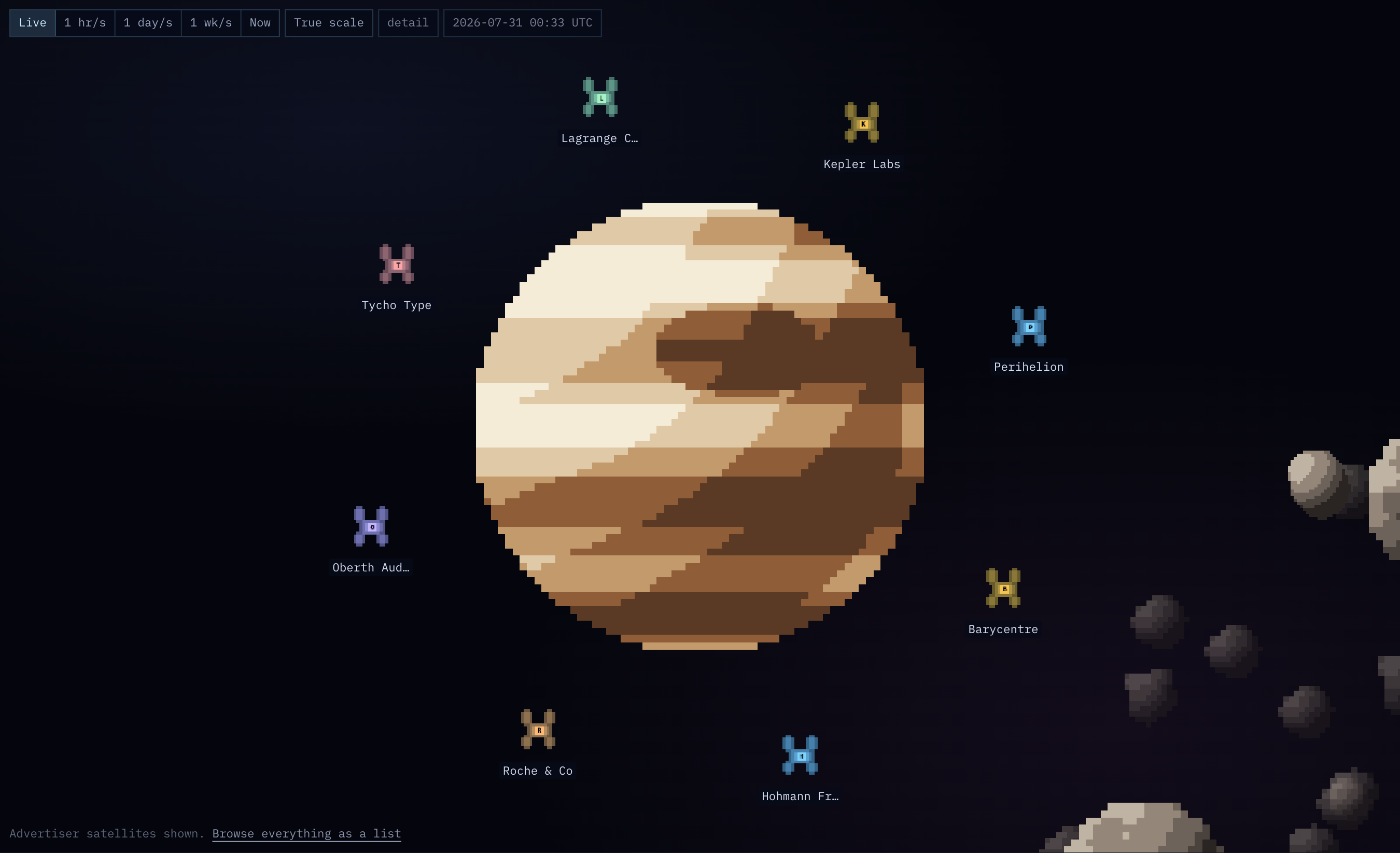
Your logo orbits a planet as a satellite. Slot count scales with the planet's real radius.
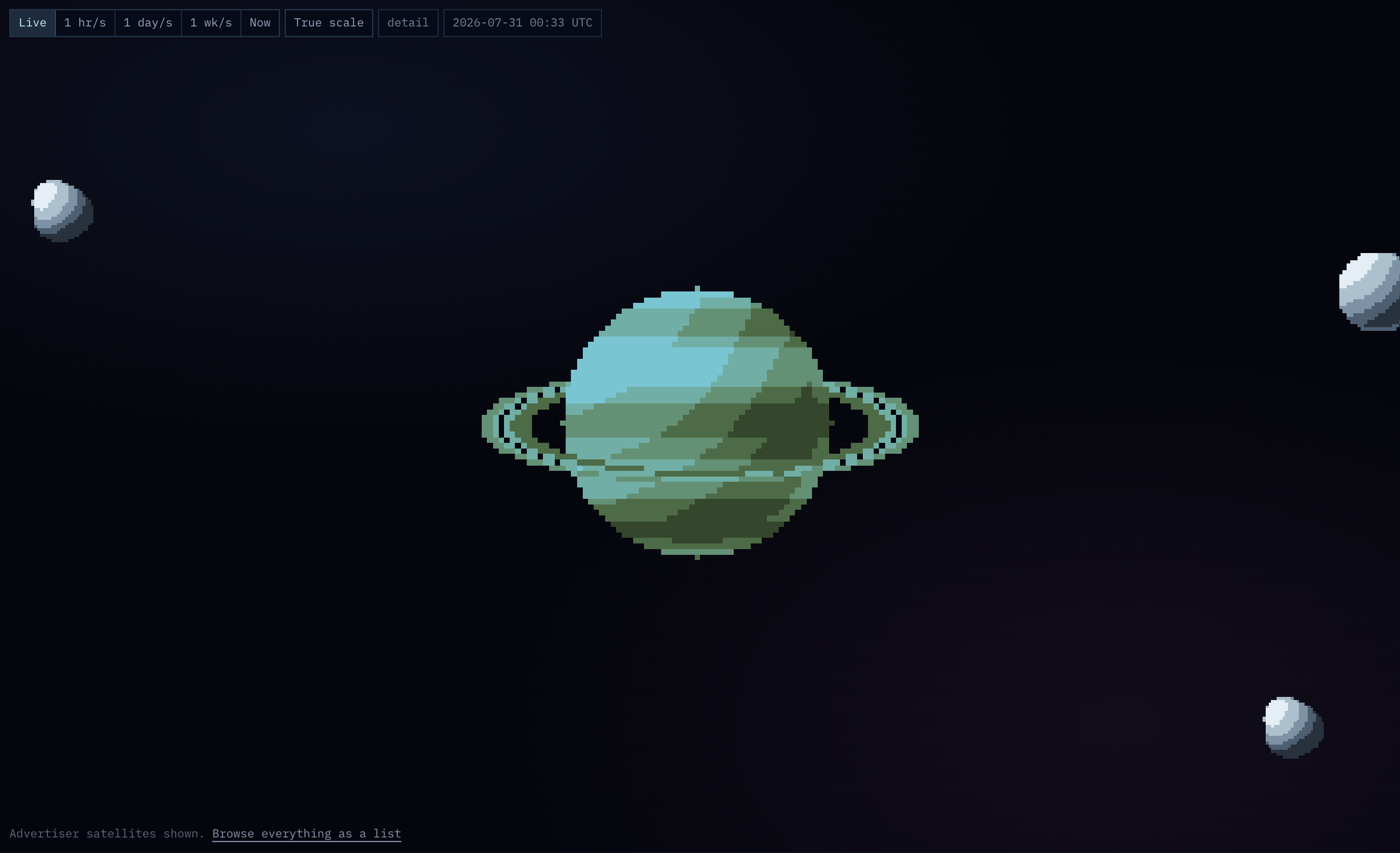
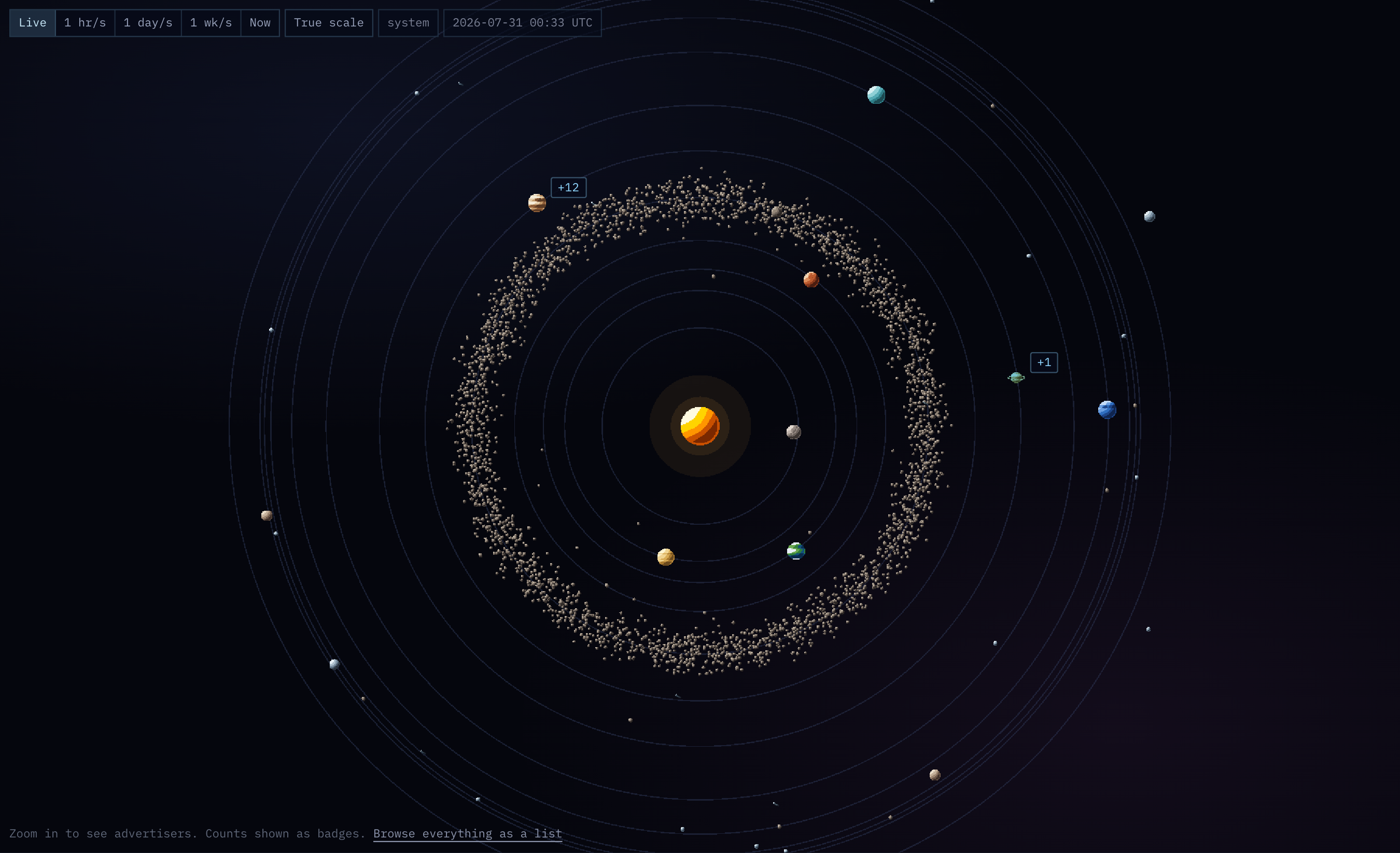
Claims are bought on the object’s own page or from the map itself. Start at the object index or open the map. A custom name on a body is shown on astrapixels.com only and is not an IAU designation.
What we count, and what we refuse to
The rate moves with measured attention, so the counting rules are deliberately conservative. Every threshold here exists to exclude something you could reasonably call padding.
- Sustained visibility
- A tooltip impression requires 400ms of continuous visibility. Sweeping a cursor across the asteroid belt fires hundreds of hover events in under a second, and counting those would inflate belt-adjacent objects by an order of magnitude.
- A hidden tab is not attention
- A surface's timer stops when the tab stops being visible. A tooltip left open under a switched-away window counts for nothing.
- Per-session daily cap
- 20 billable impressions per placement per session per day. Without it, one person leaving the map open on a second monitor generates unlimited impressions against a competitor's slot.
- The device split is never blended
- Desktop and touch are reported as separate rows on your own report page. Blending them would count a surface that was never shown on the device it was credited to.
- The client proposes, the server decides
- The browser reports what happened without pre-filtering, and the server applies every rule above. One place decides what is billable, so your report page and our invoice cannot disagree.
- No raw event stream
- Impressions are aggregated into daily totals and the raw events are never stored. There is no per-visitor tracking data here to lose, and no profile of your customers to sell you.
- No forecast
- We report what happened. Nothing on this site is a projection, and the rate above is arithmetic over a number you can check rather than an estimate of what next month might do.
The binding version of the billing rules, including how the rate escalates and what makes an impression valid, is in the rented surfaces section of the terms. That page governs; this one explains.
What we will not run
Nothing buyer-supplied reaches the map without moderation, and that cuts both ways: your creative is reviewed before it renders, and so is everybody else’s. The content rules, the refund position and the link-health policy that applies to a claim are all on the terms page. A link from a rented placement is nofollow, on every surface, and we make no claim about what a link here does for your rankings.